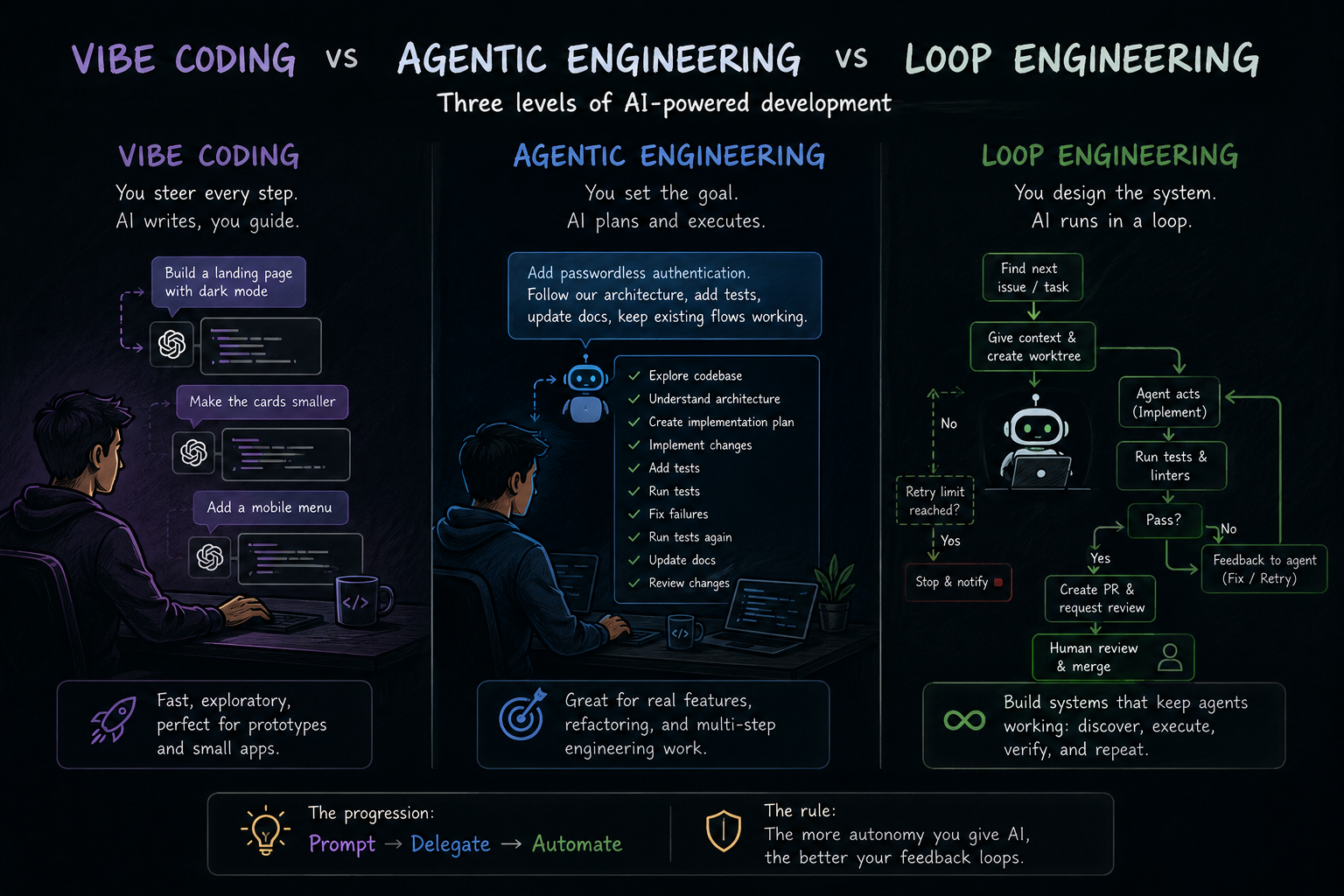
Vibe Coding vs Agentic Engineering vs Loop Engineering: How AI Coding Is Evolving AI has changed software development pretty quickly. Not long ago, using AI to write a few lines of code felt like a big deal. Now AI tools can explore a codebase, make changes across multiple files, run tests, fix errors, and sometimes work on a task for a long time without much help from the developer. That has also created a few new terms. Three of the ones you will hear more often are vibe coding, agentic engineering, and loop engineering. They are related, but they describe different ways of working with AI. The easiest way to understand them is to look at how much responsibility the developer gives to the AI. Vibe Coding Vibe coding is probably the easiest one to understand because most developers have already done some version of it. You tell the AI what you want, it writes the code, you look at the result, and then you ask it to change something. For example, you might say, "Build me a landing page with a pricing section and dark mode." Then you might say, "Make the cards smaller." Then, "Add a mobile menu." Then, "The spacing looks weird. Fix it." You are basically driving the development process through a conversation. The AI does most of the typing, but you are still deciding what happens next. This is great when you want to move quickly. It is especially useful for prototypes, small tools, experiments, and testing an idea before spending a lot of time building it properly. The problem is that things can get messy surprisingly quickly. If you keep asking an AI to patch whatever is wrong without paying attention to the underlying architecture, you can end up with duplicated code, inconsistent patterns, and technical debt. That does not mean vibe coding is bad. It just means there is a point where asking AI to keep patching things is no longer the best way to build the software. Agentic Engineering Agentic engineering takes a different approach. Instead of telling AI what to do at every step, you give it a larger task and let it figure out how to complete it. For example, instead of saying "create this file" and then "update that function," you might give an agent a task like: "Add passwordless authentication to the application. Follow the existing architecture, add tests, update the documentation, and make sure the current authentication flows still work." The agent can then explore the codebase, figure out how the existing system works, make a plan, change multiple files, run tests, find problems, fix them, and test again. The developer is still responsible for the important decisions. You decide what needs to be built, what constraints the agent has to follow, and what a successful result looks like. But you don't necessarily have to guide every individual step. This is the biggest difference between vibe coding and agentic engineering. With vibe coding, you are usually thinking, "What should I ask the AI to do next?" With agentic engineering, you are thinking, "What can I give the agent responsibility for?" That makes agentic engineering much more interesting for production work. It can be useful for implementing features, refactoring code, writing tests, fixing bugs, and other tasks that require several steps. Loop Engineering Loop engineering takes the idea one step further. Instead of just giving an agent a task, you build a system around the agent so it can keep working through tasks with minimal human intervention. Imagine you have a backlog with hundreds of small issues. A loop could pick the next suitable issue, give it to an AI agent, provide the relevant context, let the agent make the changes, run the tests, and send any failures back to the agent. If the tests fail, the agent gets another chance. If everything passes, the system might create a pull request and move on to the next task. A human can still review and approve the changes before they reach production. The important part here is not just the AI agent. It is the entire process around it. You have to decide how the agent gets its context, how its work is tested, what happens when something fails, how many times it can retry, when it should stop, and when a human needs to step in. In simple terms, the loop might look like this: Find a task → Give the agent context → Agent works → Run checks → Fix or retry → Review → Repeat That is why loop engineering feels like a different level of abstraction. You are no longer just using an AI developer. You are designing a system in which AI developers can keep doing useful work. The Three Approaches The easiest way to compare them is to think about the amount of responsibility being handed over to AI. Vibe coding: You guide the AI step by step. AI writes and changes the code. Agentic engineering: You give the AI a goal. The agent plans and executes the work. Loop engineering: You design a system that gives agents work, checks the results, and lets them continue working. So the progression is roughly: Prompt → Delegate → Automate Why Loop Engineering Is Interesting Imagine you have 100 small issues in a codebase. With vibe coding, you might sit down with an AI assistant and work through them one at a time. With agentic engineering, you could give larger tasks to an agent and let it handle all the individual steps. With loop engineering, you could potentially build a system that keeps picking up suitable tasks and sending them through the same process automatically. At that point, your job changes a little. You are spending less time thinking about individual lines of code and more time thinking about whether the system is reliable. Does the agent have enough context? Are the tests good enough to catch mistakes? What happens if the agent gets stuck? How many times should it retry? When should it stop and ask a human for help? Those questions become more important as you give AI more freedom to work on its own. The Risk of Automating Bad Processes There is an obvious downside to all of this. A bad prompt can produce bad code. A badly designed agent can produce a lot more bad code. And a badly designed automated loop can keep producing the same mistake over and over again. This is why testing and verification become more important as AI becomes more autonomous. Good tests, type checking, linting, code review, security checks, staging environments, and clear requirements are not things that become less important because AI is writing the code. They become more important. If an AI agent is going to make changes while you are away from your computer, you need a reliable way to tell whether those changes are actually good. Which One Should You Use? There is no reason to choose only one approach. If you are building a quick prototype or trying out an idea, vibe coding can be incredibly effective. You can get something working quickly without spending days setting up the project. If you are working on a real product and want AI to handle larger pieces of implementation, agentic engineering is probably a better fit. You give the agent a clear goal, let it do the work, and review the result. If you have lots of repetitive tasks that are well defined and easy to verify, loop engineering becomes much more interesting. Things like small bug fixes, dependency updates, test maintenance, documentation updates, and other well-scoped work can potentially be handled through automated loops. And in practice, you might use all three. You could vibe-code the first version of an idea, use agentic engineering to turn it into a proper product, and eventually build automated loops to handle some of the repetitive maintenance. That is probably the most useful way to look at these terms. They are not three competing ways to write software. They are different levels of AI involvement in the engineering process. Vibe coding is about using AI to write code quickly. Agentic engineering is about giving AI responsibility for completing engineering tasks. Loop engineering is about building systems that allow those agents to keep working, checking their own results, and moving on to the next task. The interesting question is no longer whether AI will write more of our code. It already is. The interesting question is how much of the engineering process around that code we can safely hand over to it.
By StartupYar Team · August 14, 2026
Vibe Coding vs Agentic Engineering vs Loop Engineering: How AI Coding Is Evolving